


It is often difficult to identify the factors guiding Donald Trump one month after the American and Israeli campaign of military action on Iran.
However, it remains clear he has his attention fixed on the global crude markets.
A comment – or tweet – from the US president concerning his strategies once would spark significant swings in prices, as market participants reacted to signs the hostilities could worsen or de-escalate.
However, in recent days, traders seem to be becoming increasingly wary about the significance of his remarks.
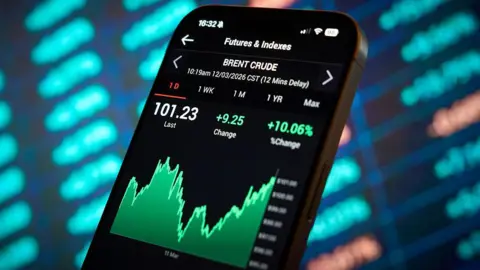
The price of oil was hovering around around $72 a barrel (bbl) prior to 28 February, when the military action against Iran began.
The week prior, it reached a high of $118 a barrel on 19 March and by Friday afternoon was trading at slightly under $112 – substantially higher than its pre-war price.
Below are key instances from the past month where Trump and the financial markets seem to have influenced each other – with differing results.
Navigate with the arrow to move to the next slide.
"Oil prices have become a proxy for wider geopolitical and economic risks, spiking when Trump's language becomes hawkish and falling back when his language becomes more conciliatory," observes one investment manager.
He continues that markets are appropriately sensitive to those messages, due to the significant financial dangers that come with climbing oil prices.
"Investors are trying to assess real volatility," he says. "The markets can seem nervous or uncertain, but what they're really attempting is navigating event risk in live, with oil positioned directly at the centre of that."
However, it can be difficult for traders to decide how to trade, given that some of Trump's remarks seem aimed at moving oil prices, as opposed to conveying policy, argues another financial strategist.
"As they say, the initial victim of war is clarity," he observes. "I suspect some of the dialogue trading of statements around successful negotiations, and the contrary, very much are aimed at merely influencing the market price of oil."
Investor Response Become Increasingly Muted
On a recent Thursday, moments after US stock markets experienced their largest decline since the outset of the conflict with Iran, Trump said discussions with Iran were going "very well" and he was postponing planned attacks on Iran's oil facilities until at least 6 April.
But, the price of crude continued to climb.
One currency strategist says that investor responses are "becoming more muted" because of the "wide divergence" between Trump's optimistic statements and the lack of confirmation from Tehran.
"Given the optics, many market watchers cannot envision an imminent conclusion to the hostilities and markets remain apprehensive."
Another market expert comments investors have also grown used to Trump "frequently altering course at hints of political, equity market or market turmoil".
"There is a degree of scepticism, or even outright cynicism, creeping in at the fringes," he concludes.

